Capacity development project, India
Objectives
In India, more than 40 million people have diabetes, yet many do not have access to appropriate treatment and as a result they experience severe complications such as diabetic retinopathy.
In Prakasam district in Andhra Pradesh, the existing public health facilities are not adequately equipped to offer even basic diagnosis and treatment for diabetes. Likewise, the eye care facilities in the area lack equipment for treatment of diabetic retinopathy.
The district is among the poorest in the state with 16% of the population living below the poverty line. Since poverty deters a person's access to the health care system, a large portion of the population is precluded from receiving proper health services.
The project seeks to strengthen the existing health care system and build capacity to deliver effective diabetes services in Prakasam district in the Indian state Andhra Pradesh.
Approach
The project is headed by L. V. Prasad Eye Institute and builds on the current capacities developed in the district under the ongoing WDF supported project "Health promotion and diabetes prevention" (WDF05-137).
Initially, a standard protocol for the care of people with diabetes and diabetic retinopathy will be developed. The protocol will subsequently be used to train various groups of professionals.
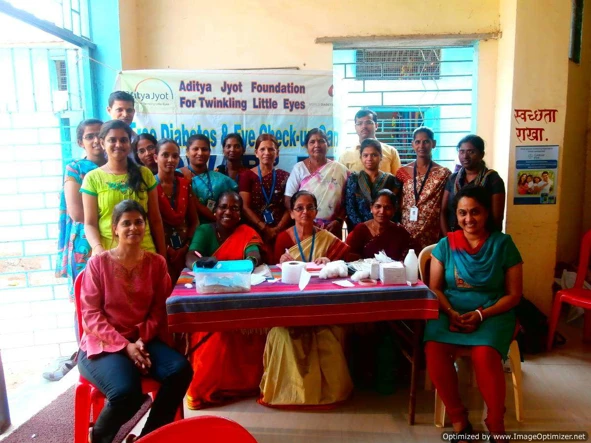
The plan is to screen for diabetes in all villages in the district and register the people who have diabetes. Comprehensive care, patient education and follow-up checks will be offered to those identified with diabetes. It is expected that 127,500 people will have diabetes in the district and thus benefit from this project.
In order to better reach people with diabetes in the villages, 600 so-called "village vision guardians" will be trained. The role of the village vision guardians is to assist in the screening and registering of all people with diabetes in the district, counsel them about lifestyle modifications, diabetes care and the importance of good control and periodic check-ups, and remind them when it is time for their follow-up examinations.
The capacities of the public health facilities and the non-for-profit organisations in the district will also be strengthened. 10 existing health centres will be up-graded with the necessary equipment and facilities for diagnosis and treatment related to special diabetes care. In addition, personnel from more than 50 health centres will be trained in standard diabetes care. Approximately 160 paramedics and 100 general physicians will be trained in order to improve the delivery of diabetes care.
In addition, seven specialist teams will be formed in the major towns in the district to ensure improved diabetes care. The specialities will be related to diabetes such as cardiology, nephrology, foot care and retina.
In the area of eye care, 30 ophthalmologists and 30 mid-level ophthalmic assistants will receive training on diagnosis and management of diabetic retinopathy. This improved capacity in the area of diabetic retinopathy will be used to carry out screening for diabetic retinopathy for all the registered people with diabetes and to provide eye examinations, laser services and surgery to the people who need it.
Meanwhile, information and education materials targeting people with diabetes, paramedical staff and medical professionals will be developed and disseminated to the relevant people throughout the project. The material will among other things inform the patients about how to take care of their health when they have been diagnosed with diabetes. Information about project activities e.g. screening for diabetes will be displayed on posters in public places.
Approach
The project is headed by L. V. Prasad Eye Institute and builds on the current capacities developed in the district under the ongoing WDF supported project "Health promotion and diabetes prevention" (WDF05-137).
Initially, a standard protocol for the care of people with diabetes and diabetic retinopathy will be developed. The protocol will subsequently be used to train various groups of professionals.
The plan is to screen for diabetes in all villages in the district and register the people who have diabetes. Comprehensive care, patient education and follow-up checks will be offered to those identified with diabetes. It is expected that 127,500 people will have diabetes in the district and thus benefit from this project.
In order to better reach people with diabetes in the villages, 600 so-called "village vision guardians" will be trained. The role of the village vision guardians is to assist in the screening and registering of all people with diabetes in the district, counsel them about lifestyle modifications, diabetes care and the importance of good control and periodic check-ups, and remind them when it is time for their follow-up examinations.
The capacities of the public health facilities and the non-for-profit organisations in the district will also be strengthened. 10 existing health centres will be up-graded with the necessary equipment and facilities for diagnosis and treatment related to special diabetes care. In addition, personnel from more than 50 health centres will be trained in standard diabetes care. Approximately 160 paramedics and 100 general physicians will be trained in order to improve the delivery of diabetes care.
In addition, seven specialist teams will be formed in the major towns in the district to ensure improved diabetes care. The specialities will be related to diabetes such as cardiology, nephrology, foot care and retina.
In the area of eye care, 30 ophthalmologists and 30 mid-level ophthalmic assistants will receive training on diagnosis and management of diabetic retinopathy. This improved capacity in the area of diabetic retinopathy will be used to carry out screening for diabetic retinopathy for all the registered people with diabetes and to provide eye examinations, laser services and surgery to the people who need it.
Meanwhile, information and education materials targeting people with diabetes, paramedical staff and medical professionals will be developed and disseminated to the relevant people throughout the project. The material will among other things inform the patients about how to take care of their health when they have been diagnosed with diabetes. Information about project activities e.g. screening for diabetes will be displayed on posters in public places.
Results at completion
• 30 government facilities, 6 diabetic centres, 3 eye centres and 16 private centers established or strengthened.
• 29,277 patients treated in the established clinics
• 134 general physicians and 30 ophthalmologists trained in comprehensive diabetic care.
• 248 nurses trained, mainly registered medical practitioners working in rural areas or from the government sector.
• 911 community workers trained during four training programs. They all work at village level and each one maintains details about 200 households.
• 808 DR screening camps have been conducted; 127,608 people screened for diabetes and diabetic retinopathy.
• 2,714 diabetes patients detected with DR and 87,567 detected with diabetes.
• 219 people received laser treatment and 3,905 received eye surgery.
• A manual on comprehensive diabetes care at the primary level developed in local language.
• 185 awareness campaigns conducted in 40 different villages reaching more than 30,000 people.
• 16, 241 patients with diabetes participated in quality of life enhancement programs.
Project information
-
Project Nr.:WDF08-0330
-
Project status:Completed
-
Intervention areas:Access to carePrevention
-
Region:South East Asia
-
Country:India
-
Partners:L.V. Prasad Eye Institute/International Centre for Advancement of Rural Eye Care (ICARE)
-
Project period:2008 2015
-
Project budget:EUR 228,318.00
-
WDF contribution:EUR 228,318.00